Pages

Tuesday, 1 May 2012

May Day Magic


First of May – Late Spring and the main planting Month

Well, they do say you should be careful what you wish for – you might get it! And, we were wishing very hard for some rain. It has now officially been confirmed that April 2012 was the wettest April since records began, well over 100 years. For many people around the country this is a tragedy, with lost livestock, destroyed homes and property and even one man drowned in the floods.
For growers, all is definitely not lost. The ground is becoming quite wet now but not yet, damagingly so. For quite some time, the rain just ran off the drought hardened earth but, it has now penetrated quite well, although yesterday, when I dug a couple of shallow ridges to plant my too well sprouted beans – Purple Teepee [dwarf purple skinned French beans] and Yinyang or Orca beans [dwarf growing variety good for drying for winter] – the ground was still not too wet. My real fear is that it is a bit too cold though, not as cold as it was last Saturday when we had our Spring Fair. Still, these beans will just have to grow or not, as they will. There were too many of them for me to pot up in my polytunnnel and I have several other varieties still waiting to be planted out.
This year I have sown beetroot [Boltardy] in pots in my polytunnel. I’m not really sure why, as I’ve never had any problems with their germination when sown straight into the ground, although it does mean I now don’t have to thin the rows. That said, each beetroot seed actually has 2 or 3 seeds in it so the young plants still have to be separated for growing on. Either way, there is a little work involved. I’m just trying this method as an experiment. It certainly saves on seed. From half a packet I have now planted out three by five metre rows where before, I would have used two packets of seed for this area. In spite of the cold weather, they seem to have settled in quite well.
It did stop raining for a few hours yesterday so, I was able to go to my plot to feed the birds and water my tunnel – odd to be carrying water in weather like this but, of course, it doesn’t rain indoors!
I lifted my first early potatoes yesterday – Vales Emerald, from my polytunnel. In my last Blog I was complaining about red ants having destroyed several of my potato plants. I have now lost a few more and on digging around their roots I have discovered another red ant nest. I’m afraid I also had to dig it out and spray again with Py. It has been quite disappointing for my crops and has somewhat reduced my sympathy for that particular branch of wildlife.
However, the potatoes I did lift were delicious and it has cleared an area in my tunnel to start planting out tomato and chillis which are now becoming slightly pot-bound.
As I am writing I hear the forecast is promising dry weather for tomorrow so, hopefully, I will be able to spend a few hours on my plot clearing an area for climbing beans, setting up the canes and, with luck, planting some out. If I can break the ground down enough I might even consider sowing some carrot and spring onions.
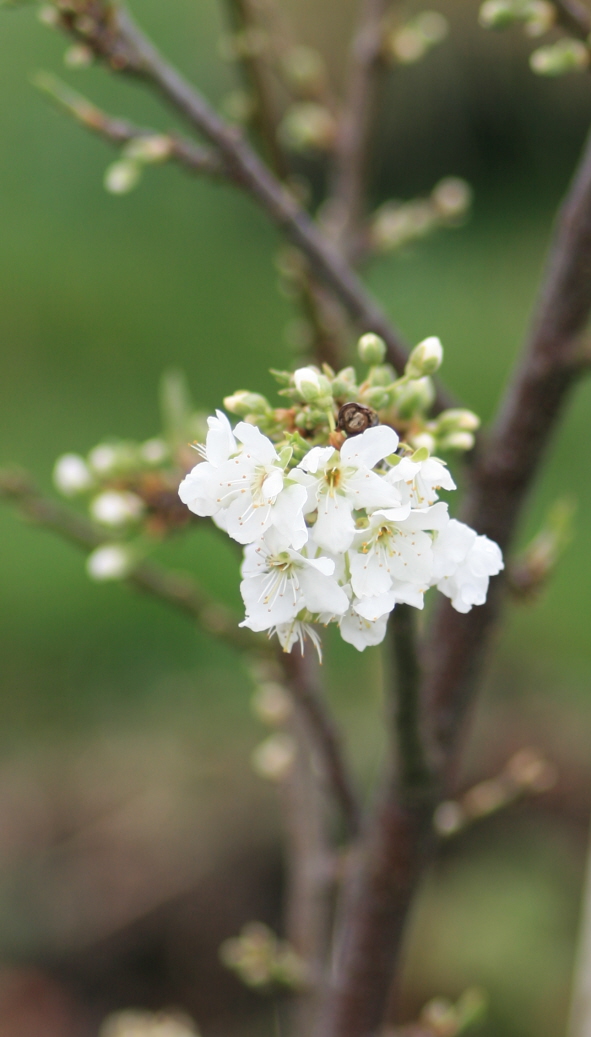
Fruit bushes and canes look fresh and healthy and are satisfyingly covered in blossom. I still haven’t used all the gooseberries I froze last summer. I might use them to make a batch of gooseberry and mint jelly – the mint is particularly lush just now – and this jelly is perfect with any roast meats but especially with lamb.
Gooseberry and Mint Jelly
Gooseberries make a satisfyingly sharp jelly especially if used while slightly unripe
900 gms / 2lbs gooseberries 
600ml/1 pint water
Sugar ( see method) 
Large bunch of mint
½ litre [1 pint] washed, dried  and finely chopped mint leaves    
Method
1. Wash the gooseberries and remove leaves or pieces of twig  - it isn’t necessary to top and tail them.
2. Put in a pan with the water and the large bunch of mint (use a large pan, like a preserving pan if you have).
3. Bring to the boil then simmer gently until the fruit is soft, approx 10 minutes. Use a wooden spoon to crush the fruit occasionally as it cooks, a little more water may be added if necessary.
4. Strain the fruit through a jelly bag or muslin bag – leave overnight. Do not squeeze the bag or the jelly will be cloudy.
5. Measure the juice and add 450g/1 lb sugar to each 600ml/1 pint juice
6. Put the juice into a clean large saucepan or preserving pan, add the sugar and heat gently, stirring to ensure all the sugar has dissolved, then bring to a rolling boil and boil rapidly until setting point is reached.
7. Skim and put into pots. Allow it to cool slightly, then add the chopped mint and stir a little to encourage the mint to mix evenly through the jelly. [If you add the mint immediately it will stay on the surface of the jelly]. 
8. Cover and seal.

Saturday, 21 April 2012

Pests on the Allotment and in the Poly-tunnel


Dealing with pests on the allotment

I have been somewhat concerned lately about a very persistent and very destructive red-ant nest in my poly-tunnel. Normally, I prefer to live-and-let-live. I have known about these ants in my tunnel since it was first erected and I was aware that the odd early potato failed to grow as the ants had moved into its ridge to make their home. This year, however, they really have become quite destructive. Of the 16 potatoes I planted, 3 have failed because of the ants’ nest in that area. Worse still, plants I was growing in pots for our Community Garden project to sell have been invaded by the ants, where they have even set up a crèche for their babies ! the cheek! have keeled over and died – very quickly.
Something more permanent had to be done.
Now, last year I had bought a garden insect killer which I understand is acceptable for organic growers as it uses natural pyrethrins, called Py. I am open to contradiction on this. [I had been informed that this compound had replaced Derris, now, no longer available.] Care must be taken near water as it is toxic to aquatic organisms and can be harmful to bees. The carton says that it kills ants but, only on contact. Yes, it does kill ants on contact and while I regret having to do it, I hope I will have no more problems with them.
Last year, at this time I was stressing about asparagus beetle. My asparagus is a particularly early variety and, this year, I have been eating it since late March. This is the first year I have been able to eat it. It has now been on my plot for three years – the time recommended to allow the crowns to establish. I have even had enough to give bundles away to friends. As I am eating it instead of allowing the spears to grow into ferns, I have not had to worry about the dreaded beetle..... yet!
Over winter, I have disturbed the ground around the plants as much as I’ve dared in the hope of exposing the adults to frost. I’ve also ensured there have been no weeds or debris around the plants where the adults might hide to overwinter. But, really I know, this is not enough. As soon as I stop harvesting and allow the ferns to grow up, the beetles will be there. The beetles themselves don’t do any harm to the plants but, they lay eggs which hatch into nasty little larvae. Those are the creatures which will devastate your plants. Unfortunately, if left to do their thing, you will have no crop next year.
Start early on the beetles themselves... pick them off and squash them. If you can see the eggs [they are only about a millimetre long] squash those too. You will always miss some which will hatch. Squash the larvae. If you can, check and do it daily. I really recommend wearing rubber or nitrile gloves !
Now the really spectacularly magic cure-all is SB Plant Invigorator [ and here you will think I have shares in the company – I don’t!]. It is non-toxic [you can eat plants you spray it on within a few hours – do read the instructions!], environmentally friendly, biodegradeable. It also acts as a pesticide, mildewcide and a foliar nutrient – I quote the blurb here.
It is, unfortunately, only available on-line [do check different sources for the best prices and think of the postage costs].
I have used this stuff for the last two years in my poly-tunnel and outdoors. Anyone, who has ever had a red-spider-mite problem will know how very difficult it is to control or eradicate. To my surprise SB Plant Invigorator succeeded. It did require spraying every-other day for several weeks [ the regular misting of the plants might also have contributed to its success].
Over the last few years I have had an overwhelming problem with whitefly on my brassicas. I can’t claim that the product removed the problem entirely but, certainly the fly problem was much reduced and the plants were amazingly healthy and strong.
Of course, slugs and snails are a perennial problem though, as I continue to till my ground, I find that the damage they cause is greatly reduced. I usually only use slug pellets on my seed beds, my poly-tunnel and around newly planted out brassicas – but, I do hate it when I bring home strong healthy heads of cauliflower to find them full of slugs.
Many of my plot neighbours use beer traps for slugs and snails and even brew their own beer for this purpose [it is so much cheaper]. In my garden at home I have not found this even slightly effective – loads of slug damage on my plants but, no slugs in the beer traps. However, I might try it again on my plot this year – more later!
Of course, at home the pests can be slightly different. I am surprised that any self respecting rat or mouse would come within a mile of my house, there are so many cats in this area and I have four of them. Not that three of my cats would pose any kind of threat to any creature. Being male they are too lazy and have no hunting skills. However, my very beautiful queen - Missy - makes up for all of them. She is a killer par excellence! This morning, while it was still murky, as I walked into my sitting-room, I stepped on somthing squishy! Closer inspection disclosed a large gutted dead mouse [perhaps a small rat - I didn't inspect it too closely]. It's mate was lying not too far away.
More on pests and problems later!

Thursday, 19 April 2012

Late April on the Allotment


Late April on the Allotment

I’m pleased to see the rain, yes, really I am and, of course it is April, when we expect a bit of rain. I’m sure farmers and commercial growers are very relieved as water is needed on crops especially when they are trying to get them established. But! I really do wish it was a bit warmer and with a bit more sunshine between showers. The birds, nesting now, are desperate for food and my robins are waiting for me each time I come to the plot. They can be quite in my face!
I have had a nasty little, flu’ like virus for a couple of weeks and I feel it has put me somewhat on the back foot as far as my allotment work has gone, especially planting my main-crop potatoes. I have now managed to get my Sarpo Mira seed in the ground [ after several years of experimenting with different varieties, I’m really taken with these. They have an excellent balance of disease and pest resistance and good flavour... and... they keep well. I only finished my crop from last year in mid February and they were still good].  I bought all of my seed potatoes from Thompson and Morgan. While I have whinged, in the past, about T&M delivering seed potatoes far too late to chit properly, this year the service has been excellent. And, they do have an excellent selection. This year I have found it particularly difficult and wearisome planting the potatoes. I’m hoping this is just because I’m been a bit under the weather and not because I’m getting past it!  However, I was chatting to a fellow plotter in the last few days who has told me that he doesn’t dig ridges for his potatoes any more – he uses a large bulb planter instead. Now that might be a method worth trying next year – at least for some of them, as a trial.
My 1st early potatoes in the polytunnel [Vales Emerald] are already putting on flower buds so, perhaps in a few weeks I will be able to start harvesting. I see the outdoor sown Vales Emerald are also well up – still under a protective layer of fleece to protect them from the frost. I have never tried this variety before – I had become quite fond of Accent as my 1st early but, this year I was unable to get them. The Vales Emerald are not, at the moment inspiring me, they certainly don’t seem to be as robust as Accent and a couple of the plants have failed to grow or have died back though, I wonder if this is due to red-ant nests which are in the vicinity. I would prefer to live with the ants but, poly-tunnel space is precious and perhaps I need to be a bit more jealous of this space.
I moved most of my young tomato plants, and a few chilli plants to my polytunnel about three weeks ago [although I can propagate them at home, I can’t provide the young plants with enough light]. I covered them with fleece until they had settled in then took the fleece off. Unfortunately, on the same day I took the fleece off we had a really hard frost. The surprising part was that the chillies were fine, tomato F1 Fantasio was fine but, Alicanti was seriously hit by the frost. That said, I won’t resow as most of the affected plants have put out side shoots which will still be way ahead of any new sowing I would make.
I have now moved lots of my seedlings, including my first batch of sweetcorn, [F1 Earlibird from Dobies] to my ploy-tunnel but, am careful to keep them covered with fleece until this cold spell has passed. I hope the weather will have warmed up by the beginning of May and I can plant my first batch of sweetcorn out. I do have another variety F1 Rising Sun [ also from Dobies] which I will leave for another week before sowing. If they all germinate as well as the Earlibird and produce good crops I will have far too much sweetcorn. But, in the past I’ve been disappointed by some crops so I’m spreading my bets. Last year I tried an experimental plot of Butcher’s Blood [a red seeded variety]. I found germination rate poor but, those seeds which did germinate, grew into tall strong plants. Unfortunately, I found the cobs tough and rather tasteless. But you have to keep trying new stuff, you never know when you will come up with something magic.
Now, at last, I have found a courgette which I actually like – F1 Orelia [ Dobies seed]. It has a golden skin and the flesh is dryer and denser than the more common zucchini. Unfortunately, last year I only had one seed germinate and this year- so far – I have had three but, guess what, I’ve broken one ! It still survives and might just make it but, I’ve resown just in case. However, I’m losing faith in my ability to germinate them... they should be easy. What am I doing wrong? Is my propagator too warm? Perhaps too cool? Should I just try them on the window sill? Any ideas would be gratefully received. Perhaps I should just get my daughter to grow them for me!
Last year I had real difficulties germinating peppers and chillies. This year, of the three varieties I’ve sown, I seem to have about 100% germination and can give them away. I think last year, the temperature of my propagator may have been too hot. Any thoughts?
My daughter loves all the different varieties of chillies she grows each year. However she lost the label on one plant she gave me. It produced purple fruit about 2cm [1 inch] long which turned red when properly ripe. Of course I dried the chillies for use over the winter. These babies are absolutely lethal! I scrunched a little one up into a curry I was making and, of course, washed my hands well afterwards. An hour later I was working on my computer and rested my chin in my hands. My face started to burn so, I rubbed it again and the burning spread to everywhere I touched. This pain lasted for quite some time! Gosh I will never learn!
So far this year I have sown two different varieties of peas. On 6th March I sowed 4 packets of Little Marvel, an early variety. I covered them with fleece, as much to protect them from predators as from frost. They are now about 15cm high [6inches] and I have staked them already. I also sowed Hurst Green Shaft on 20th March. They are still under a layer of environmesh but in the coming week I will remove this also and stake them. They are looking good.
Following advice I was given a couple of years ago on growing a pea crop – I sow lots of seed into each trench. My plot is about 5 metres wide. I will create three trenches about 3 – 4 cm deep [1½ inches]. I have divided 4 packets among the 3 trenches which is really fairly dense sowing. However, compared with the advice often given on sowing pea seed, this method has had spectacularly successful results. Let’s face it, the seed is not so expensive that we need to be precious about each seed. My crop last year filled a complete drawer of my freezer with bags of frozen peas. I am just coming to the end of them now.

Wednesday, 18 April 2012

Easter Holiday Activities - Westonbirt


Easter Holiday Activities – Westonbirt, the National Arboretum and Malmesbury
Well, we have now had our much longed-for rain and Easter weekend was definitely not seaside kind of weather. I believe we are now back to more seasonal temperatures though, I think possibly those people who have had to deal with heavy snowfalls would disagree with that.
The ground on my allotment is now diggable again after the long hot dry spell and I must plant the rest of my maincrop potatoes in the coming week.
On Good Friday morning I picked my daughter and her partner up from the station in Bristol and we headed out onto the M4 with the intention of visiting Westonbirt. Although we have lived in the Westcountry for nearly a quarter of a century neither my daughter nor her partner had ever visited the Arboretum before. My fault, I’m sure. My younger daughter and I are fairly frequent visitors. That said, I still managed to miss the correct exit from the motorway [the Bath turnoff] and drove on to the next one. I then couldn’t understand why I didn’t recognise any of the little Wiltshire villages we drove through. However, my daughter, expressing her disgust at my lack of direction and organisation, whipped out her trusty Smartphone and directed me back in the direction of Westonbirt.
We drove slowly through the town of Malmesbury, partly because the streets are narrow and partly because we were fascinated by the place. Although I have heard of it, I had never visited the town before. Situated in Wiltshire at the South end of the Cotswolds and between the banks of two different rivers Avon it has been built around Malmesbury Abbey which was established in the 7th century A.D. Part of the Abbey is now in ruins but I gathered the main part of it is still in use. The town itself goes back to the 9th century and was awarded its charter by Alfred the Great. Although the town has around 400 listed buildings, I don’t think any of them go back that far – the Abbey excepted. However, enchanting though it was, the purpose of the day’s trip was to explore the Arboretum not Wiltshire towns. It will have to keep for another occasion.
For me to get to the Arboretum [ the quickest route!] is to leave the M4 at junction18, also signposted for Bath but heading north on the A46. After a few miles take a right hand fork onto the A433. Westonbirt itself is a few miles further on and is clearly signed. A few miles further on you would come to the small town of Tetbury, another of the quaint and ancient Cotswolds towns.
The Arboretum is situated in Gloucestershire and was established by the Holford family on land in the village of Weston Birt in the first half of the 19th century. It was taken over by the Forestry Commission in 1956. The Arboretum covers an area of approximately 600 acres [ 2.4km²] and has about 17 miles of safe walks through various areas. It is said to have one of the best tree collections in the world, collected from many countries with temperate climates around the globe.
Probably the most popular times to visit are the spring time when many trees are on flower – the exquisite magnolias and cherry trees and the gorgeous rhododendrons. But, the autumn provided colour of the different type when the leaves of the trees [mostly the huge range of acers] provide a startling display from rich crimsons, bright oranges, sienna and ochre, dazzling yellows and sombre browns.
There is always lots for young families to do– various activities are arranged to keep them entertained while they learn to love the environment, fresh air and freedom. Dogs are welcomed too and in some of the more remote walks many of the owners allow them off their leads to snuffle among fallen leaves and bracken for traces of wild animals and other interesting smells. I have been disappointed to see that some owners don’t bother to clear up the toileting activities of their pets, in spite of clear requests to do so.
In the main reception area the range of food available at the cafe is fresh and tasty if not exactly cordon blue but it is very welcome when you have spent several hours tramping around among trees. The toilet facilities are clean, plentiful and well looked after.
If you think it might be worth a visit do have a look on the Website for activities which are organised regularly throughout the year Popular events include the Live Music concerts programme, Treefest and the Enchanted Christmas illuminated trail.’
On this occasion, we didn’t walk too far as we had decided we would have a photographic competition among ourselves. And what wonderful photographic opportunities there are.

Sunday, 1 April 2012

London - Greenwich, Greenwich Park, Greenwich Market, Etc


Visiting London – Greenwich Park, Greenwich Penninsula, Cutty Sark and all that!
I love Bristol. I love living in this city with its culture, warmth, vibrancy and community spirit – and of course, its beauty. But there is nothing to beat regular trips to London to experience several levels up of a few of those sensations. The warmth of community may be missing – it is such a vast, multi cultural city but, there is a buzz of excitement, innovation, technology, development which is not apparent anywhere else in the country – even in these days of recession. Of course, the 2012 Olympics have a strong influence on that.
My daughter has just bought a new flat over-looking the Thames from the Thames barrier to the O2. I went to London to, ostensibly, help her to move house. I’m not sure I was much use but, it was wonderful to be there as part of this experience and to voice enraptured reflections on the view from her pent-house patio. I have already booked my bedroom! Years ago, when I lived in London, I would never have dreamt of visiting the East End. My life had been built around areas like Hampstead, Pimlico, Holland Park, Maida Vale and the West End and at that time it was where life was ‘happening’. But, today, the exciting life of London has moved East. I have been introduced to new areas and experiences in London I have never visited before and I hope I will experience a few more in the coming months and years. The new London Gondola Lift across the Thames from close to the O2 Centre on Greenwich Peninsula to the Royal Docks close to the new 2012 Olympics main areas. This is still under construction but, a few days ago they have added the main cables and the gondolas should be added well in advance of the Olympics. It is planned for 1km of cable car line across the Thames to the site and is, I believe, the first cable car in the UK.
This morning, we decided, after a hearty breakfast, still in my daughter’s old flat, that we would catch a bus from the Millennium Village from Oval Square [don’t you just love that?] to Blackheath. This is an old and very expensive part of London just above Greenwich Park and overlooking the City of London, Canary Wharf, etc. Blackheath is in the Royal Borough of Greenwich which has a long history with royalty dating back to 1433. Henry VIII introduced deer there so that he could go hunting in the park and reportedly, some of them still remain in the park, although, today, I didn’t see any. Now, Greenwich Park is – and deservedly so, a World Heritage site.
As I had never before visited the east end of London, neither had I visited the Royal Observatory at Greenwich – famous for Greenwich Mean Time [GMT]. It was good to have visited it at last and, although interesting, ancient telescopes and chronometers are not really my thing. Though you can book personal time at their famous telescope, which could well be worth trying.
Greenwich Park will be used as part of the 2012 Olympic Games venue and part of the Park will be closed off for the events. If you are planning to visit this area, do Google for information on what is happening, transport and what areas will not be available without tickets. As I understand, of the 19 events which will be happening in this area there will be: Equestrian events and Paralympic equestrian events; jumping, dressage and eventing. Also Modern Pentathlon.
We wandered down through the park through Greenwich Market to the now reconstructed Cutty Sark. Although this site won’t be open again until late April 2012 it already looks exciting. I believe, the Cutty Sark had a lot of its superstructure removed prior to a major fire in 2007 which destroyed much of the remaining structure of this 18th century clipper ship. It seems that the old masts and original visible superstructure will be original. Although still cloaked in scaffolding, the original masts and rigging have now been replaced and, although difficult to photograph, especially from a mobile camera, with its new glassed in walk way, it looks amazing and well worth a visit in the future.
We didn’t spend too long with the Cutty Sark as my favourite method of London travelling was approaching fast and we had to, in fact, run for the queue – the London Clippers. I just love them! If you visit London you should really try this method of river transport. The Clippers go from the Royal Arsenal at Woolrich Pier, through Greenwich and up the Thames, under the Tower Bridge to the City of London. This has to be my favourite method of transport through London though, it doesn’t give any explanation of the historic sites and events around London – for that, do look at other river trips – these are an excellent introduction to this wonderful and historic city.
Back in Bristol, some neighbours are holding a Sunday night barbeque party – noisy and scenting the night with wood smoke. It reminds me of how happy I am to return to Bristol and my home. Although evocative of other times, I must go to bed in preparation for some much needed attention to my allotment in the morning.

Monday, 26 March 2012

Officially Springtime - planting peas, potatoes, parsley, et al


Another Early Spring, and Threats of Drought!
I think I am fairly safe in saying it is now officially springtime. Our clocks reverted to British Summertime on Saturday night.
I’ve just been checking the weather and temperatures around the country today – Bristol – a cloudless sky since early morning with daytime temperature - 17ºC [forecast for 4ºC for tonight]; London - 17º - 19ºC [forecast for 5ºC for tonight]; Newcastle upon Tyne - 19º - 20ºC [forecast for 6ºC for tonight]. It’s interesting that the area which should logically be the coldest is, in fact, the warmest.
Like last spring, we are having very warm temperatures with low rainfalls very early in the year. The birds are well on with nest building and – a reminder to all bird lovers – they do need feeding and a good source of water at this time of year. I am seeing lots of magpies, robins, crows, pigeons, tits, sparrows and dunnocks but, unfortunately, very few blackbirds. I fear the large numbers of magpies around my area have a significant impact on the numbers of blackbirds.
I have been looking back on my blogs from this time last year. Certainly then, I was noticing that spring had come early and birds were already nest-building earlier than this year. However, I didn’t start worrying about the shortage of water until May. This year there is already a lot of concern about the low level of water in our reservoirs [mostly due to low rainfall last year as well as this winter and spring]. Commercial growers are bracing themselves for a disastrous season. The pond at the bottom of our allotment fields is already very low and newly hatched tadpoles are becoming stranded on the fast-drying mudbanks.
As with all weather conditions – which, let’s face it, we can’t alter anyway – there are major positives. I have managed to get a large area of my plot dug over – just a little each day, which will then be ready for later planted crops such as beans, brassicas and salad crops. I must still dig patches for sweetcorn, courgettes and some later plantings of other vegetables.
Autumn sowings of broad beans now have their flowers on and my spring sown crops are growing on well. 

My first sowing of early peas [Little Marvel - Dobies] is well up but are still covered with fleece to keep the pigeons off. I have now sown a second crop [Hurst Green Shaft – Dobies – which were amazingly successful last year but, my frozen supply is now at an end, unfortunately]. I have also covered them to keep mice and birds from the seedbeds – this time with Environmesh.
It is difficult to decide which protective medium is best. Of course fleece is so much cheaper but, although it can be washed, is really only useable for one season. It will protect your crops from pests, birds and frost. However, Environmesh, although so much more expensive, has all the uses of fleece but, is much more durable. I will expect it to last me for many years. The cost is definitely a major consideration but, I’ve been building up my stock by putting it on my Christmas and birthday present lists for several years. My family is very sensible about buying for presents what is really wanted. And, my children, who now each have their own allotments, are more than happy to have essential allotment supplies bought for them on these occasions.
I have several outdoor seed-beds now which are, unfortunately, having to be watered on a regular basis – parsley, spring onions, 2 varieties of sorrel, 2 varieties of carrot, coriander and parsnips. So far, only the spring onions are starting to appear.
In my poly-tunnel, my early potatoes are up, brassicas in seed beds are showing their second true leaves and a bed of Cos lettuce [Winter Gem – Vaila] are growing on well. .I have moved young, potted-up chilli, pepper and tomato plants from my house as they are in desperate need of better light where, I hope, they will not be attacked by a heavy late frost. This year, I am planning that my poly-tunnel will be used for crops which I will use – tomatoes, which I like [no experimental varieties!], chillies [mostly Joe’s Long, though I’m open to more unusual varieties from my daughter] and peppers. This space is limited and precious and I have discovered that, in my area, these crops do not do particularly well outdoors – tomatoes because of blight and the peppers and chillies as it is really, just not sunny enough and warm enough.
The fruit trees are starting to show their blossom and over the next few weeks I expect the display will be spectacular!