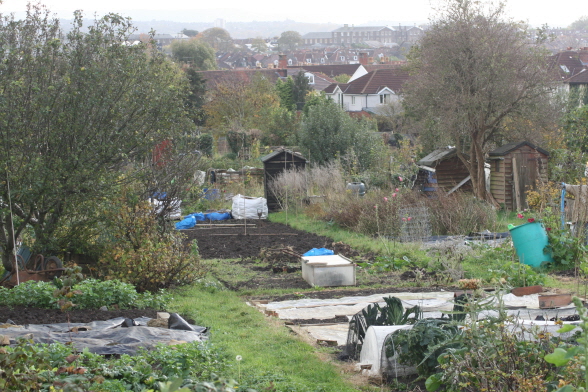
April
on the Allotment
 April…. the beginning of British Summertime. The
clocks have just been put forwards [2 days ago] so, I guess it is British
Summertime. I suppose I have to say at least, that it is spring.
I know that everyone has their own pet time for
planting potatoes. Many of my fellow plot holders wait until Good Friday. For
me this is not a good guide as Easter falls on a different date each year and
it has no relationship to the weather. In Ireland, traditionally the first of
the potatoes were planted by St Patrick’s Day [17th March] and I
have always aimed to have started my potato planting by then.
However, this year the ground has been so wet for so
long that the seed houses didn’t send out my potato seed until the beginning of
March – and then they had to be chatted. That said, the chitting has been quite
quick this year and I did manage to plant my two little ridges of 1st
Earlies by 26th March.
I had planned to put in some other seeds as well as
it had been dry for some days and I had managed to complete some useful digging
and bed preparation but, it was such a bitterly cold day that I couldn’t bring
myself to plant any other seeds.
This year, April is going to be a very busy year for
sowing
o
Maintenance
 -
Keep the allotment tidy –for most allotment
sites, and certainly for mine, bonfires are no longer allowed. Of course, there
is always a debate about whether we should burn our rubbish anyway. Many people
feel that all organic matter should be composted. In-organic rubbish should, in
any case be taken home and disposed of safely away from the allotment [glass,
metal, plastics, etc]
-
It is likely that many winter maturing
vegetables will now have finished producing crops. Remove these [stems of
Brussels sprouts and Kale and stumps of others which may have been left in the
ground], reducing the opportunities for pests and diseases – clear these beds
and dig over for new crops. Dig in compost or well rotted manure though not on
proposed carrot or parsnip beds which will encourage the carrots to fork
[fang];
-
Weed carefully around perennial plants
[rhubarb, globe artichokes, asparagus, etc] to avoid disturbing the roots,
before mulching with compost or manure;
-
Tidy strawberry beds – remove dead
leaves and any remaining ‘runners’ be careful to not break off the growing points of mature plants. New
growth will already be springing through.
-
Grass and weeds on paths around your
allotment and beds will now be showing serious growth. Some perennial weeds
such as dandelions will already have set seed heads. Keep grass cut back and
remove weed seed heads [and deep roots] before they have an opportunity to
disperse seeds.
-
It is advisable, if you are at the
allotment on a dry sunny day, to leave the doors of greenhouses or polythene
tunnels open to allow for ventilation but, be sure to close up again before you
leave. There are still hard frosts which will damage young plants.
o
Preparation

-
If you have covered rhubarb to force an
early crop, it is advisable to remove the covering to allow the plants to grow
normally as the forced stems are likely to be quite brittle and ‘stretched’.
Early varieties will already be ready for harvesting;
-
Remove troublesome and deep-rooted
perennial weeds [dandelion, dock, cinque-foil, couchgrass, horse-tail,
bind-weed, etc] before digging over beds;
-
On autumn dug ground, now is the time to
remove any weeds which may have sprung up and lightly dig or rake over the beds
ready for planting;
-
Prepare seed beds as soon as the weather
and ground have warmed up [by preparing seed beds I
mean that the ground should be well dug, clods broken up and raked to a fine
tilth so that the seeds can be sown into fine smooth soil. It can be helpful to
rake in some seed or potting compost in the top layer to help this process.
With carrots and parsnips, to help with a fine, stone-free, clod-free ridge it
can be useful to dig out a narrow ridge about 6inches [15cm] deep and fill it
with potting compost - water it well and sow your seeds into that];
-
If planning to sow seeds in greenhouse
or poly-tunnel [in seed beds or pots] bring compost and containers of water
inside to allow them to warm up before sowing. Each day, as you leave the plot,
put containers of water inside to allow them to defrost for the next watering;

-
Check the pH of your ground.
The rain will probably have leached a lot of lime from the soil. Remember the
optimum pH for most plants is a little over 6 [slightly acid], although some
prefer an alkaline soil [over 7] and a few, like most ericaceous plants [acid loving plants like heathers, rhododendrons, pieris, azaleas, etc.] like it
a bit lower. You can buy a fairly cheap pH monitor from many hardware or
gardening stores – push the prongs into the ground and it registers the pH
measurement on a screen. It isn't very accurate but will give an indication of
whether or not you need to add lime. If you are adding lime - don't put it out
at the same time as manure - they react together and the Nitrogen will be lost
in gas. If lime is necessary, don't try to correct all at once - add a sprinkle
on the chosen patch each year. One of my neighbours adds a spoonful around each
brassica plant as she plants them out – in this way a different area is sorted
each year.
-
Sort your packets of seeds
into groups of those which should be sown March /April for earlier sowing;
those which should be sown March to June for the middle of the month and for
those which should be sown April / May closer to the end of the month. Be
guided by the weather and the conditions. Most planting times on seed packets
allow for a range of times.
o
Sowing
and Planting
April is usually a frantic month on the allotment –
digging, weeding, strimming, planting and sowing.
If
you have not already done so, and you have an electric propagator, set it up
this month. You can sow chillies, peppers, aubergines, cucumber and tomatoes
for growing indoors. Although they
should be sown in February/March it is not too late and it is important to have
somewhere warm enough and more importantly, light enough to grow them on once
they have germinated. It is important
that when you transfer these delicate plants to your greenhouse or polytunnel,
the hard frosts are over – they will need the stronger light but will not be
able to tolerate very cold temperatures. As in every year, this can be a
careful balance. My dream is to have a large heated greenhouse where I can
propagate seeds in perfect conditions and grow on in perfect conditions. Then
have a 50ft tunnel [or 3] where I can produce amazing crops every year but
- -
- dream on!
In
a poly-tunnel or greenhouse – in pots, trays [or seedbeds – but remember that
some plants don’t respond well to transplanting and those that do can still be
occupying space later in the season that you will need for indoor crops, you
can now sow –beetroot, broccoli/calabrese, brussels sprouts, summer and winter
cabbage, early carrots, celery, celeriac, kale, lettuce, radishes, rocket and
spring onions,
-
Outdoors, you can now sow [taking the
conditions and the weather into consideration] – broad beans, broccoli
/calabrese, Brussels sprouts, summer cabbage, carrots, summer cauliflower,
leeks, lettuce, onions, spring onions, parsnips, early peas, potatoes, radish,
rocket, spinach,and my favourite crop- parsley - Oh yes, and don’t forget the
seed potatoes [hopefully already ‘chitted’]. I usually start my 1st
Earlies in March but this year is very late and it is certainly not too late to
plant them.
-
Plants which have been sown germinated
indoors can now be planted outside [make sure the weather and conditions are
suitable and that the plants have been ‘hardened-off’ first] – broad beans, French
beans [though I’d be careful of late frosts] ,sweetpeas, lettuce, early peas,
summer cauliflower, winter cauliflower.
-
You can now sow indoors – in a poly
tunnel or green house – aubergines, runner beans, Brussels sprouts, broccoli and
calabrese, winter cauliflower, lettuce, onions, celery, celeriac, courgettes,
cucumbers [indoor and outdoor], peas, peppers and chillies [though now quite
late for them to produce a mature crop], pumpkin and squash, rocket, spinach,
spring onions, sweet corn, Swiss chard, outdoor tomatoes,
-
Bought-in plants – usually these are not
available in garden centres or in nurseries until it is time to plant them but this
does not take into consideration any changes in weather.

 Asparagus crowns and globe
artichokes should be available for planting now although I have already
harvested my first meal of asparagus [albeit a small one]. Some varieties will
no longer be available. I have noticed that, at least 1 on-line and catalogue
nursery is now selling asparagus crowns already established in large planters.
I haven’t tried these and they are quite expensive but for outside-the-back-door
and patio growing this might be a way forwards. Have a look for these in the
autumn
o
Harvesting
-
Leeks are still okay, and even some late
sown parsnips
-
some
varieties of broccoli and cauliflower also.
-
Spring cabbage should be good now, some
winter cabbage may also still be useable.
-
Some kale is still useable though, most
is now running to seed.
-
Salads -early sown lettuce, radishes,
new fresh spinach leaves, over wintered spring onions are good now
-
Swiss chard
-
Last year’s parsley is putting up new
fresh growth as are marjoram, thyme, rosemary, mint and tarragon.