Pages

Showing posts with label Peas - Little Marvel. Show all posts

Tuesday, 3 July 2012

Summertime and the living is seriously disappointing!


It’s early July and the rain is still falling! The forecast is not giving us any hope of the weather improving. I gather, in France, the weather has been fairly similar this ‘summer’ and that this kind of weather is referred to as ‘English weather’ there – gee, I wonder why!
That said, for some crops this cool wet weather has been really good [though not the high winds, which have really been quite damaging] but the rain, while providing excellent conditions for slugs and snails, has also boosted growth in my brassica crops, beetroots, carrots, raspberries, squashes and pumpkins, courgettes and many of my herbs are taking over.
This year the usual clouds of whitefly around my brassicas are conspicuous by their absence and, although I have seen some blackfly on my broad beans, they have not been overwhelming – and I haven’t pinched out the tops as I normally would.
The tomato plants, peppers and chillies in my poly tunnel are lush and are showing potential heavy crops though, I do worry that we might not have enough sunshine to ripen the fruits. Actually, while I’m trying to put a positive spin on the weather – I usually try to promote the idea that any weather will be good for some crops while not so good for others – but, I find that, this summer, I’m struggling to keep my chin up.
Over the weekend, all of my children have been home and have stripped my early pea patch [Little Marvel, sown on 6th March]. They did harvest a couple of good buckets full which were shared out but, the crop was kind of disappointing. It had been knocked about so much by storms, eaten by pigeons and slugs that, I believe, the crop was probably reduced by a third. However, we have had our plot inspections over the last couple of weeks and I have heard many plot holders complain of really poor pea crops. This makes me feel that mine has not been too bad. I still have three strong rows of Hurst Greenshaft, sown 20th March to harvest and they still look quite good.
I am considering sowing a late pea crop. The seed providers say that they can be sown up to and including July. I have never tried to sow peas this late before and I’ve been told by one of my more experienced neighbours that late sown peas are more likely to have maggots [not nice!]. My daughter wonders if I have heard of supermarkets which sell already frozen peas ! But, while there may be little difference in the flavour, the pleasure is in being able to fill your freezer with a winter’s supply of peas from your home grown produce. I have the seed, which would happily keep ‘til next season if necessary and if it stops raining for long enough in the next few days, I might just dig over the area and re-sow. Perhaps it is worth the effort just so that I can report back on the results.
I have been harvesting good crops of courgette F1 Orelia – a yellow variety. I was somewhat dismayed, a few weeks ago, that the leaves of all of the plants have turned yellow or a mixture of yellow and green. I worried that this might be the result of a mineral deficiency but it was suggested that this was typical of this golden variety. I love them. This variety of courgettes  with the denser drier flesh, suits my cooking preferences.
My beetroots this year, are excellent. As I have said in an earlier blog, I sowed in pots in my polytunnel then planted out when at the 2nd true leaf stage. Although planted into some fairly rough ground, they have come on well and I have harvested and cooked lots. Because they were planted out from the pots no thinning was necessary. My daughters have also headed home with bags of tennis-ball sized beetroots each.
I am already concerned about my tunnel crops. I have been spraying reasonably frequently with SB Plant Invigorator [discussed in full in previous blogs] which seems to have encouraged fairly lush growth in the tomato plants. Already many of the plants have full sized green fruits but, with the cool, sunless weather, these fruits might struggle to ripen. Already, I am finding the large green and brown caterpillars which caused so much damage in the last two years. I wouldn’t mind them too much if they just ate the leaves of the plants but, they also nibble on the fruits. The damage attracts the botrytis spores [grey mould], which are everywhere, and much of the fruit can be destroyed.
The red ants, which have caused so much devastation in my poly tunnel this season are still present, in spite of my attacks on them and the introduction of the baited ant traps. Though, at least they have not caused any more damage to my crops. They seem to have moved to the untilled edges now.
Well, of course, this is a diffucult year. And I do mean it when I say that - whatever the weather, it is good for some crop or some aspect of allotment growing. But, I just hate the thought of going into another winter without having had a summer. I'm sure this strikes a chord with any people. However, we still have July, August and September to hope for something better. Keep your hopes up!

Friday, 15 June 2012

Dealing with the cold June on our plots


Mid June and it’s chilly for June!
I have always had a particular view of what to expect from the months and the different seasons. As I was growing up, there were lots of sayings about the different months, for example ‘March comes in like a lion and goes out like a lamb’, ‘a wet and windy May fills the barns with corn and hay,’  ‘April showers’. However, there is a general expectation that each season will ‘do’ what is expected in most years. Particularly in the British Isles, we do expect cold [ish] wet weather of varying degrees in winter. We expect it to become gradually warmer though, still wet [ish] in the spring, gradually becoming warmer still and a bit drier through May, June and July. Although August is supposed to be the real summer month, I have rarely known it to be hot and dry. It always seems that the best weather happens when children are stuck in school taking exams then, when they are on holiday from late July, it starts to rain.
Over the last three years here, in south west England, the weather has been so abnormal that I’m beginning to wonder if there is really a ‘normal’.
We have had two unusually, extremely cold winters and, for three winters in a row, I have not been able to supply myself with vegetables throughout that season – even leeks, of which I had a good supply, were frozen into the ground. Last year and this, we have had very hot early spring times which have made it difficult to establish crops as the ground was so hard and dry – this year as early as March [I actually got sunburnt!]. Since then, barring a couple of short, very dry but still quite cool weeks between the end of April and the beginning of May, it was so dry and windy that the ground dried out, becoming unworkable very quickly, even the weeds were struggling. For the rest of the spring and early summer season, it has remained cold, wet and windy.
Many plants are suffering or even being destroyed by a mixture of bird, ant, flea-beetle and slug attack, and destruction from high winds. Plants are growing so slowly that they are gradually being eaten away by all of these problems before they get to the harvesting stage. On visiting my son's allotment, I noticed he has ant traps in his greenhouse. When I quizzed him about them, he told me he had introduced them succesfully to his house when invaded by ants and was now trying to ensure they didn't cause problems in his green house. The ants [it takes only a few, to visit the traps and take the poison back to the queen and the nest, wiping out the whole colony] have been particularly destructive this year on my alloptment and I have bought a couple of pre-baited traps [how organic is that? not at all but I am at my wits end on trying to eradicate these very destructive and vicious red ants from my poly tunnel]. I will let you know how it works - or not!
So far, this season, I’ve managed to harvest a fairly steady supply of broad beans and early potatoes. I have stopped harvesting asparagus though my globe artichokes are just starting [those which have not been broken off by the high winds]. Don't forget to check for those very destructive asparagus beetles [see a previous Blog for information] so far, this year, I have only seen two beetles. But, of course, on an allotment, they will be all around us.
I’m hopeful that I will be harvesting peas in a couple of weeks. My first crop will be Marvel and my intention is to wait until most of the crop is ready then harvest and freeze for the winter. The wind has knocked a lot of the vines over but, I am hopeful it won’t have done too much damage. My second crop – Hurst Green Shaft – is surrounded by a boma [an enclosure created by canes and fleece to keep birds out and the wind from knocking them down]. They might be ready in a month’s time, GW! Strawberries are ripening very slowly and birds [I suspect blackbirds] are eating them as they do. Raspberries are also beginning to ripen – my son and I picked a small punnet of them a couple of days ago.
Fruit has been particularly hard hit this year. There is a very poor set on most fruit trees. Perhaps some of the later flowering apple trees have fared better as they flowered when the rain stopped. No doubt this is a result of the bees being unable to fly out during the long wet month of April. This must surely have affected the development of the bee colonies.
For many of my crops, because I have the time to do it and because I have the enthusiasm in the growing, as much as the eating of the crops, I have re-sown, sometimes twice, [several varieties of beans and coriander] to try to ensure a harvest. A few weeks ago, after a poor start, I ended up with so many squash and pumpkin plants, I was giving them away to my neighbours. Now, I find that the high winds have broken off the best and most advanced ones and slugs have eaten away the smaller ones. Maybe I won't have so many after all.
This has been a very whinging Blog, my apologies. Usually I try to reinforce my strongly held view that each year is difficult for some things but will be brilliant for others. Mostly, I am trying to express understanding for all those growers who are also experiencing difficulties, it happens to the best of us. It has also made me wonder what a ‘normal’ year is. Can we depend on there being such an event? As for the storms we have been experiencing – as I remember, as a child, that we had storms during many Junes, when my father would lose his much beloved boat – driven up onto rocks on the shore. This happened on at least three occasions[that I remember] and at least three boats were written off but, I guess, in the course of 15 years or so, this was not too unreasonable, just memorable when it happened.
As I glance out of my window, I see that the rain has stopped and there are actually some visible patches of blue sky between the scudding clouds. My barometer is low and not moving up but, when I tap it gently, neither does it dip lower. Perhaps tomorrow will be a better day. I have plans!

Monday, 26 March 2012

Officially Springtime - planting peas, potatoes, parsley, et al


Another Early Spring, and Threats of Drought!
I think I am fairly safe in saying it is now officially springtime. Our clocks reverted to British Summertime on Saturday night.
I’ve just been checking the weather and temperatures around the country today – Bristol – a cloudless sky since early morning with daytime temperature - 17ºC [forecast for 4ºC for tonight]; London - 17º - 19ºC [forecast for 5ºC for tonight]; Newcastle upon Tyne - 19º - 20ºC [forecast for 6ºC for tonight]. It’s interesting that the area which should logically be the coldest is, in fact, the warmest.
Like last spring, we are having very warm temperatures with low rainfalls very early in the year. The birds are well on with nest building and – a reminder to all bird lovers – they do need feeding and a good source of water at this time of year. I am seeing lots of magpies, robins, crows, pigeons, tits, sparrows and dunnocks but, unfortunately, very few blackbirds. I fear the large numbers of magpies around my area have a significant impact on the numbers of blackbirds.
I have been looking back on my blogs from this time last year. Certainly then, I was noticing that spring had come early and birds were already nest-building earlier than this year. However, I didn’t start worrying about the shortage of water until May. This year there is already a lot of concern about the low level of water in our reservoirs [mostly due to low rainfall last year as well as this winter and spring]. Commercial growers are bracing themselves for a disastrous season. The pond at the bottom of our allotment fields is already very low and newly hatched tadpoles are becoming stranded on the fast-drying mudbanks.
As with all weather conditions – which, let’s face it, we can’t alter anyway – there are major positives. I have managed to get a large area of my plot dug over – just a little each day, which will then be ready for later planted crops such as beans, brassicas and salad crops. I must still dig patches for sweetcorn, courgettes and some later plantings of other vegetables.
Autumn sowings of broad beans now have their flowers on and my spring sown crops are growing on well. 

My first sowing of early peas [Little Marvel - Dobies] is well up but are still covered with fleece to keep the pigeons off. I have now sown a second crop [Hurst Green Shaft – Dobies – which were amazingly successful last year but, my frozen supply is now at an end, unfortunately]. I have also covered them to keep mice and birds from the seedbeds – this time with Environmesh.
It is difficult to decide which protective medium is best. Of course fleece is so much cheaper but, although it can be washed, is really only useable for one season. It will protect your crops from pests, birds and frost. However, Environmesh, although so much more expensive, has all the uses of fleece but, is much more durable. I will expect it to last me for many years. The cost is definitely a major consideration but, I’ve been building up my stock by putting it on my Christmas and birthday present lists for several years. My family is very sensible about buying for presents what is really wanted. And, my children, who now each have their own allotments, are more than happy to have essential allotment supplies bought for them on these occasions.
I have several outdoor seed-beds now which are, unfortunately, having to be watered on a regular basis – parsley, spring onions, 2 varieties of sorrel, 2 varieties of carrot, coriander and parsnips. So far, only the spring onions are starting to appear.
In my poly-tunnel, my early potatoes are up, brassicas in seed beds are showing their second true leaves and a bed of Cos lettuce [Winter Gem – Vaila] are growing on well. .I have moved young, potted-up chilli, pepper and tomato plants from my house as they are in desperate need of better light where, I hope, they will not be attacked by a heavy late frost. This year, I am planning that my poly-tunnel will be used for crops which I will use – tomatoes, which I like [no experimental varieties!], chillies [mostly Joe’s Long, though I’m open to more unusual varieties from my daughter] and peppers. This space is limited and precious and I have discovered that, in my area, these crops do not do particularly well outdoors – tomatoes because of blight and the peppers and chillies as it is really, just not sunny enough and warm enough.
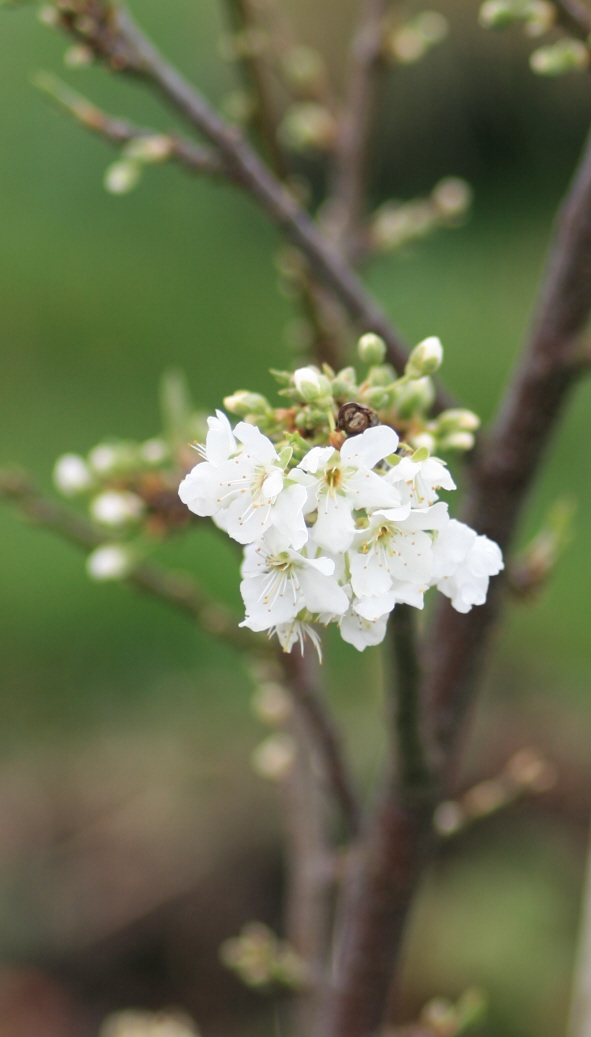
The fruit trees are starting to show their blossom and over the next few weeks I expect the display will be spectacular!